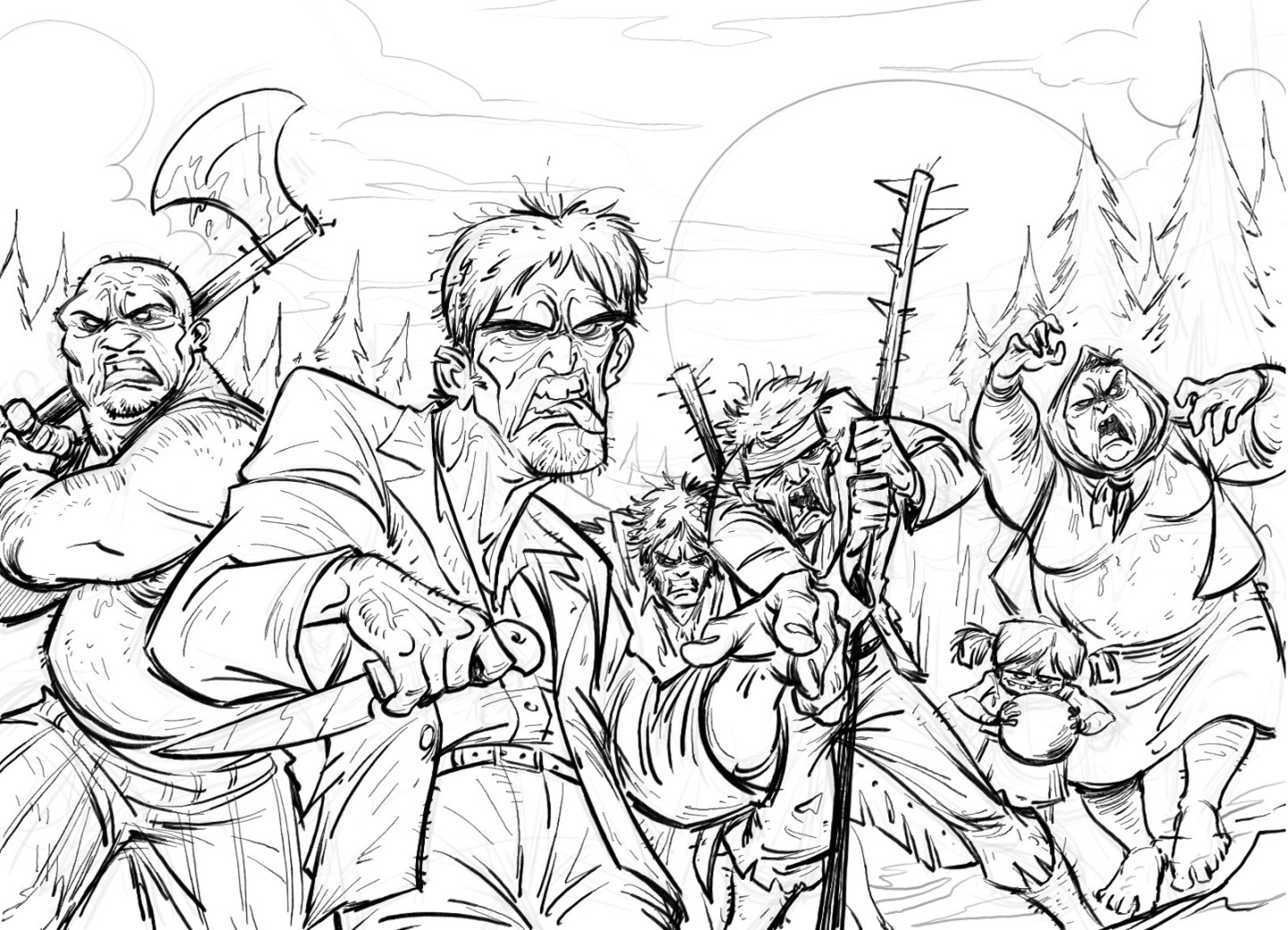
Published in Dawn – illustration by Ahmet Tabak
Less than two months before he died from cancer, American writer John Cheever, his now-disgraced biographer tells us, accepted the National Medal for Literature. He had to hobble across the stage with the help of his wife, months of cancer treatment having left him “pitifully frail”. Yet his motto was intact: that literature was salvation of the damned. “A page of good prose,” he told his cheering audience, “remains invincible.” Remembered fellow author John Updike, “All the literary acolytes assembled there fell quite silent, astonished by such faith.”
Fast-forward to the present: the smartphone is grafted to our hands; our eyeballs are fused to the short video format; and we all feel the need to upload pictures of breakfast for the viewing pleasure of neo-Nazis in the comments section. But whatever the hazards of this alien invasion, its main flying saucer has now landed: ChatGPT. Then Gemini. Then Claude.
We were told this final boss, artificial intelligence, was inevitable; that our own thoughts could safely be farmed out to robots. It was the same way the internet killed the newspaper, because print was dead. When YouTube mauled network television because the media was corrupt. When Grok and Elon gutted Twitter because race riots were respectable again.
For a while now, we have been witness to this great debasement of human thought. But ever since chatbots and their billionaire bosses have come for writing itself, we stand to lose the most vital part of ourselves.
Consider: AI does not feel. It does not dream (though it does, we are told, hallucinate). A study of personal statements from 370,000 students tells us that after ChatGPT appeared, essays had smoother language but lacked creativity. A separate study found that human-written essays offered up to eight times more new ideas, whereas even short stories were far richer in their offbeat magic.
A lot of this is because of how our brains work: to be human is to connect two seemingly unrelated subjects, based, as one educationist wrote, on linking “unique personal experiences”. A racetrack could mean an old friend; a song the death of a loved one.
But machines, on the other hand, generate words divorced from thought. They predict words that are best placed to complete a sentence, based on the books that have been pulped to train them. That is, after all, the essence of AI writing: authorship without intention. As far back as 1964, “the first book of free verse written by an electronic computer” was published in Montreal with such gems as, “The apple shapes the world, but the rain enhances the grapes” – AI slop’s noble ancestor.
That’s not to say it hasn’t its uses, if in the right doses: coding, translation, synthesis, data-crunching, infographics, customer service. It’s good for the despised work email, the Excel spreadsheet. It is, at its best, a semi-competent sounding board: not for no reason has AI slop colonised every last post on LinkedIn, that other land of brutal banality.
But what a disaster for students to outsource the single most beautiful outcome of education – critical thought – to this glorified calculator (“We just use it for proofing and professionalising our own drafts,” they always say, forgetting that the real skill, for coherence of thought, has always been revision). What a waste that countries must run dry because the office intern can’t teach himself how to spell “carbon dioxide”. And what intellectual dishonesty for grownups to claim a robot’s drivel as their own in essays, speeches, and publications in general. If the author cannot respect their audience enough to do the hard work of thinking through what they wish to express, then the audience needn’t respect the author with their time and attention either. Send us the prompts you put in instead. We’ll read those.
I think, therefore I am. If there’s a modern equivalent, it is: I generate, therefore I consume. But if I consume far more than I create, then that may be getting the whole point of existence backwards. Might we return to the business of real life; to the leaves on the trees? To human connection?
To go back to where we began, AI cannot mimic John Cheever’s writing style beyond a vapid ghost of the original, because it is only the original that lets the reader touch midlife’s misted glass, or feel the bracing need for a redemption just beyond reach. His journals, whenever someone stumbles across them, are a revelation. As The Paris Review put it, “How thrilling to discover…this offhand, extemporizing masterpiece, a storehouse of incomparable lyricism – no one writes light or water or fire better than Cheever – commingled with the greatest index of shame in American letters.”
No chatbot could have written that sentence. It’s a human being telling us what another human being meant to him.

